 EN
EN
 AZ
AZ
 RU
RU
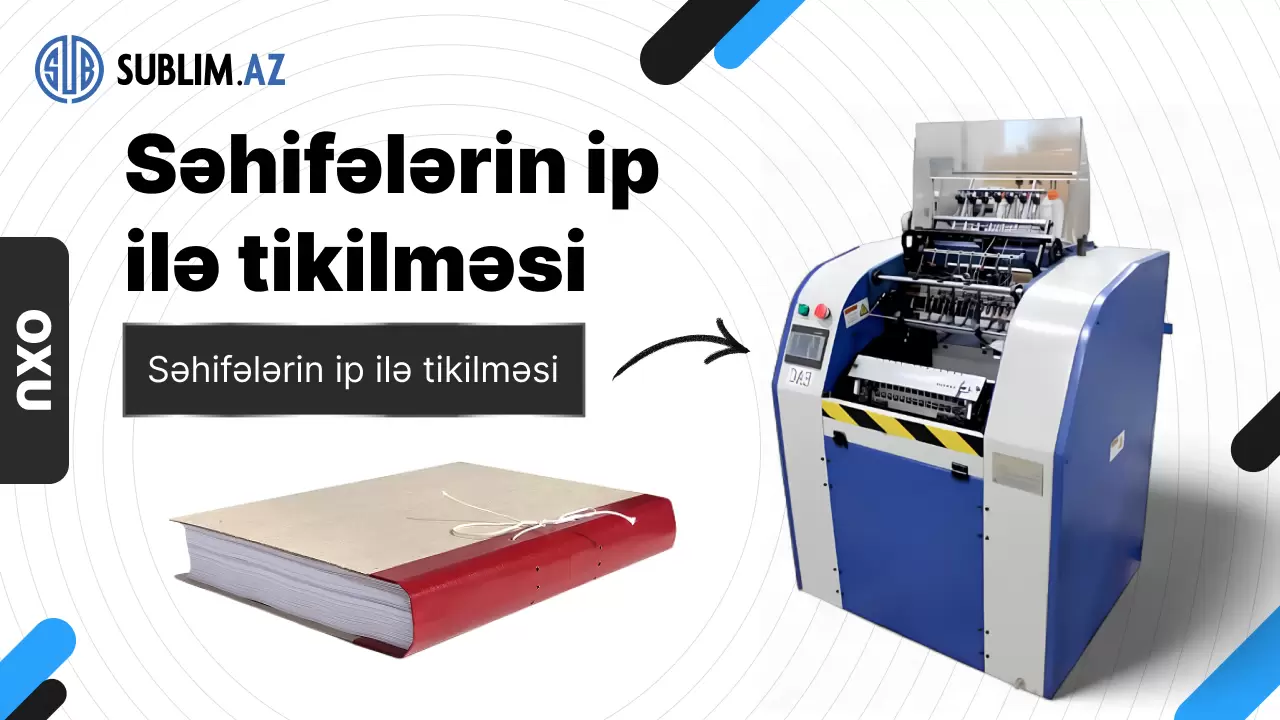
Thread Sewing of Pages
Thread Sewing of Pages (Sewing with Threads)
Thread sewing is a durable technique primarily used for producing high-quality softcover and hardcover books. This method offers numerous creative possibilities, such as an open spine (where the book’s spine is visible) or using different types of paper and colored threads.
During sewing, folded and gathered sheets are sewn individually and then bound together along the spine using continuous nylon thread. Typically, a folded sheet consists of 16 pages, though 8-page and 4-page sections are also common.
Nowadays, this process is usually performed by machines, but some bookbinders sew books by hand: sheets are sewn with a single thread, and then blocks are connected along the spine with tapes or threads. These tapes appear as perpendicular protrusions on the spine, and their ends are later glued under the endpapers to attach the book block to the cover.
Step-by-step process:
-
Printed sheets are folded.
-
Folded sheets are gathered into a single booklet.
-
The gathered sheets are sewn.
-
Adhesive is applied to the sewn book block.
-
The result is either a softcover or hardcover book.
Machine Sewing Method and Block Preparation
When sewing by machine, the gathered sheets are opened in the center and punched with a special needle at intervals of approximately 1.5–2 cm. Various types of needles are used: punching needles, hammer-style needles, and threaded sewing needles. Each sheet forms an individual block, and all blocks are sewn together into a booklet.
The thread-sewn book block is initially loose, gaining strength only when adhesive is applied to the spine. The block is then trimmed on three sides and inserted into a hardcover or softcover.
Types of Sewing
Depending on the project and paper type, different sewing techniques are used:
-
Simple sewing: the thread is in the same position for each block. This may cause a thickened spine, which can create issues in further processing.
-
Shifted sewing: the thread is shifted by one stitch length for each block. This reduces thickening in the spine, especially noticeable for thin paper or books with many blocks.
Block Thickness and Volume
Even thick book blocks can be sewn with thread. The maximum number of pages depends on the specific sewing machine. A key condition is that the total number of pages is divisible by 16, 8, or 4, as standard blocks consist of these sizes.
Durability, Value, and Print Runs
Thread-sewn books are very durable and long-lasting, maintaining their shape and quality for years.
-
Durability: Ideal for daily use, e.g., textbooks, encyclopedias, and frequently opened books.
-
Value: Thread sewing is more expensive than glued binding because the process is longer and technically more complex. However, the higher quality and longevity justify the additional cost.
-
Print runs: Mainly used for medium and large print runs. For very small runs, it may not be cost-effective, but it can still be used if high quality is required.
Aesthetic Possibilities and Design Features
Thread sewing stands out not only for durability but also for aesthetic advantages:
-
Open spine: Creates a visual effect where the stitches are visible along the spine, giving a modern and creative look.
-
Colored threads: Threads can be chosen to match the paper or cover design, enhancing uniqueness and aesthetic value.
-
Material mixing: Different paper types can be combined to create unusual and interesting designs.
-
Handmade elements: Hand-sewn books carry special value, appearing more original and artistic.
In summary, thread sewing provides extensive technical and visual possibilities in book design.